Iron in Well Water: Stains & Metallic Taste | Gridline

Water Problem

Iron in Water

Iron in water causes orange, red or brown staining and a metallic taste. The important distinction is what form it's in: iron that's still dissolved looks clear at the tap and turns orange after sitting, while iron that's already oxidised arrives visibly discoloured. Those two are treated differently — which is why "I have iron" isn't enough to specify a system.

Try this first Fill a clear glass and let it sit for twenty minutes. Clear at first, then orange sediment at the bottom? That's dissolved iron. Orange from the moment it leaves the tap? Already oxidised.

What causes iron in water?
Dissolved or oxidised iron
Which water sources does iron affect?
Primarily well water
How is iron in water usually treated?
Oxidation & filtration
Is testing needed for iron?
Yes — form and level both matter

Step One

What You May Notice

  • Orange, red or brown staining in sinks, tubs, toilets and shower bases
  • Laundry coming out rust-tinged; whites gradually turning orange
  • A metallic taste, most noticeable in cold water and in coffee or tea
  • Water that looks clear at the tap but discolours after standing
  • Orange residue in the toilet tank, dishwasher or ice maker
  • Reddish-brown slime in the toilet tank or on fixtures — can indicate iron bacteria
  • A musty or earthy smell alongside the staining
  • Staining that's worst where water sits or drips slowly
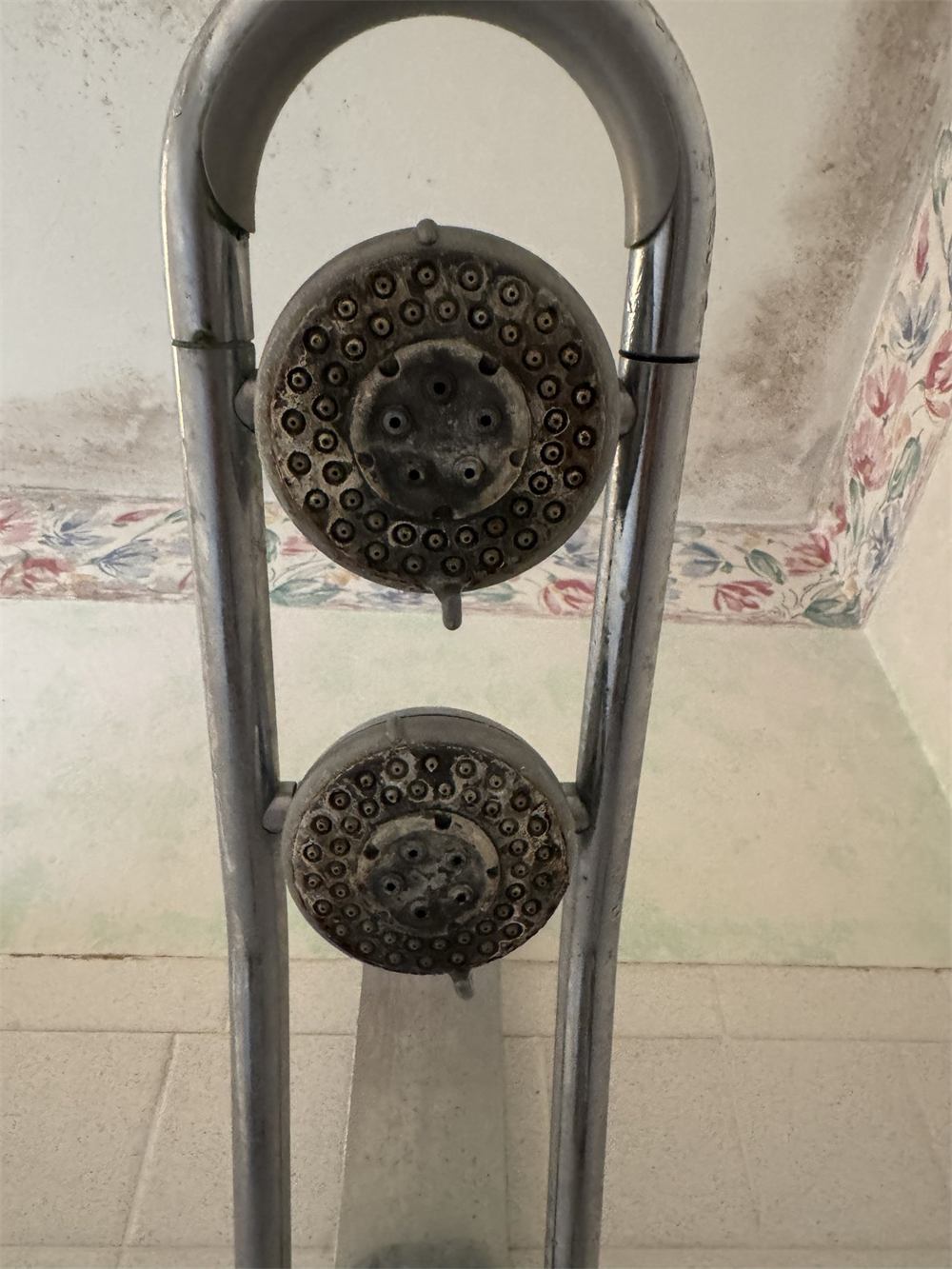
Heavy mineral buildup clogging the nozzles of two shower heads, caused by iron and manganese in low-pH well water
A customer's shower heads after iron and manganese built up in the nozzles — low pH in the well water kept both dissolved until they hit air.

Why this one needed more than a filter swap

Clogged nozzles like these are usually the last stage of a problem that started upstream. Once we confirmed low pH, iron and manganese together, the fix was pH correction first, then oxidation and filtration — not another shower head.

Step Two

Common Causes

  • Naturally occurring iron in groundwater

    Iron is one of the most abundant elements in the earth's crust. Groundwater moving through iron-bearing formations dissolves it along the way, which is why it's so common on private wells across this region.

  • Dissolved (ferrous) iron

    Iron held in solution, invisible at the tap. It oxidises when it meets air — in a glass, in the toilet tank, in the wash — which is when the orange appears. Treatment usually involves converting it to a filterable form first.

  • Oxidised (ferric) iron

    Iron that's already reacted and is present as visible particles. The water looks discoloured immediately. This is more a filtration problem than an oxidation problem.

  • Iron bacteria

    Naturally occurring organisms that feed on iron and leave behind a reddish, slimy residue. They can foul well components, plumbing and treatment equipment, and often require disinfecting the well in addition to filtering.

  • Corroding iron or galvanised plumbing

    Sometimes the iron isn't coming from the water source at all. Older galvanised pipe can contribute iron, which points to a plumbing issue rather than a treatment one — and we'd tell you that rather than sell you a filter.

Step Three

What Testing Can Tell You

  • Total iron level. The number that determines what capacity the treatment needs.
  • Whether it's ferrous or ferric. Dissolved versus already oxidised — this changes the approach entirely.
  • pH. Directly affects which oxidation methods will work. Low pH can make otherwise appropriate treatment underperform.
  • Whether manganese is also present. The two frequently occur together and manganese generally needs a higher pH to oxidise.
  • Signs of iron bacteria. Which changes the approach from purely filtration to filtration plus disinfection.
  • Hardness. Affects how the system is sequenced with a softener, if one is needed.

For context, iron appears under the EPA's secondary standards, which address aesthetic characteristics such as taste and staining rather than health-based limits. More on the process: how Gridline evaluates water.

Step Four

Potential Treatment Approaches

Which one fits depends on the level, the form, the pH and what else is in the water.

Oxidation followed by filtration

The most common approach for dissolved iron. The iron is converted into a filterable form and then removed by the media. Several oxidation methods and media types exist.

Depends on: iron level · pH · manganese present · required backwash flow rate

Iron treatment

Filtration for already-oxidised iron

Where iron is present as visible particles, a filtration-led approach may be appropriate — sometimes with sediment prefiltration ahead of it to handle the load.

Depends on: particle load · particle size · flow rate

Sediment filtration

Softener handling of low-level dissolved iron

Some softeners manage limited dissolved iron alongside hardness. But a softener is not an iron filter — using one as a substitute shortens resin life and usually disappoints.

Depends on: iron level · form · resin type · manufacturer specifications

Water softeners

Well disinfection where iron bacteria are present

Filtration alone doesn't address bacteria that recolonise. Disinfecting the well and plumbing is usually part of the approach, and may involve coordinating with a well contractor.

Depends on: bacteriological findings · well construction · recurrence after treatment

Well-water treatment

Step Five

When to Contact Gridline

  • You're cleaning the same orange staining repeatedly and it keeps returning
  • Laundry is being discoloured or ruined
  • The staining appeared suddenly or has been getting worse
  • You're new to a well and haven't established a baseline
  • You have an existing iron filter that's stopped keeping up
  • There's reddish slime in the toilet tank or on fixtures
  • You're also noticing a sulfur smell or black specks alongside the orange
  • You're buying a property with a well and want to know what you're taking on

FAQ

Iron Questions

Iron is one of the most abundant elements in the earth's crust. Groundwater moving through iron-bearing rock dissolves it along the way, which is why iron is so common on private wells. It can also come from corroding iron or galvanised plumbing inside the home — in which case the source is your pipes rather than your water.

Iron treatment across Greater PhiladelphiaCommon on private wells throughout Bucks, Montgomery and Delaware County.

Next Step

Let's Find Out What Form Your Iron Is In.

The level and the form together determine the treatment. We'll evaluate both before recommending anything.

Call Free Consultation