
Service
Well-Water Treatment Systems
Well water can look, smell or taste different from home to home. The right treatment system depends on what's actually in the water — which is why we don't quote a well-water system over the phone.
If you're on a well Pennsylvania doesn't regulate private wells the way public systems are regulated. Nobody tests your water but you — and a baseline is the most useful thing a well owner can have. How testing works
What We Find
Conditions Commonly Found in Well Water
These are the concerns homeowners on private wells most often bring to us. Several frequently occur together, and the combination changes the right approach — sometimes substantially.
Iron
Orange, reddish or brown staining in sinks, tubs and laundry; a metallic taste. Whether iron is dissolved or already oxidised changes the treatment.
Iron in well waterManganese
Black or dark brown specks and staining. Often present alongside iron, and it generally requires different handling.
ManganeseSulfur / Hydrogen Sulfide
The rotten-egg smell. Sometimes only from hot water, which points somewhere different than a whole-house odor.
Sulfur odorSediment
Sand, silt and fine particulate that clouds water, clogs fixtures and wears on any equipment downstream of it.
SedimentHardness
Very common on wells in this region. Scale, spotting and lather problems, treated with ion-exchange softening.
Hard waterAcidic Water / Low pH
Blue-green staining on fixtures and wear on copper plumbing. Addressed through acid neutralisation.
Acidic waterNon-Negotiable
Why Testing Comes Before Equipment
With municipal water, you can often make reasonable assumptions about what's in the supply. With a private well, you can't — and that's not a sales position, it's just how wells work.
Symptoms overlap
Staining can be iron or manganese. An odor can come from the water itself or from a reaction in the water heater. The visible symptom often doesn't identify the cause.
Concentration drives design
"There's iron" isn't a specification. How much iron, and in what form, determines whether one approach works and another fails.
Conditions interact
pH affects how iron behaves. Sulfur affects media choice. Hardness affects what should be installed first. These decisions can't be made in isolation.
Wells change
Water quality can shift with season, water table, pump changes or nearby activity. A reading from five years ago may not describe today.
It prevents wasted money
The most expensive well system is the one that doesn't fix the problem you called about.
It's honest
We can't diagnose your water from a phone call or a website form, and we won't pretend otherwise.
System Design
Well Systems Are Usually Several Components, In Order
Homeowners often expect "a well water system" to be one tank. In practice, when a well has multiple conditions, treatment is typically staged — each component handling one thing and protecting the next.
The order matters as much as the parts. Sediment ahead of equipment that would otherwise be fouled by it. pH correction before treatment that depends on pH to work properly. Iron treatment ahead of a softener so the resin isn't fighting a job it wasn't built for. Get the sequence wrong and individually correct components can still produce a poor result.
This is also why we're cautious about single-product answers. When someone recommends the same system for every well, the sequence question hasn't been asked.
We don't prescribe remotely
Gridline does not diagnose water conditions over the phone or from a form submission. We'll happily talk through what you're seeing and what it might indicate — but a recommendation comes after we understand the water, not before.
Specification
What Affects a Well-Water System Design
Test results
Which conditions are present, and at what levels. Everything else follows from this.
Multiple conditions
Iron plus sulfur plus hardness is a different design problem than any one of them alone.
Well yield and flow rate
Some treatment requires a minimum flow to backwash properly. A low-yield well constrains the options.
Pump and pressure tank
Existing pressure and tank configuration affect what can be installed and how it performs.
Household demand
Occupants, fixtures and usage patterns determine capacity and recovery requirements.
Space and drain access
Multi-stage systems need room and, for backwashing components, an adequate drain.
Seasonal variation
Some wells behave differently across the year. Worth knowing before specifying.
Your priorities
Sometimes a homeowner wants the odor gone first and will phase the rest. That's a legitimate plan, and we'll build toward it.
Maintenance appetite
Staged systems have more service points. We'd rather match that to what you'll realistically keep up with.
How We Work
Our Approach to Well-Water Systems
Free consultation
We ask what you're noticing, when it started, whether it's constant or seasonal, and what's already installed — including anything left by a previous owner.
Evaluate the water
Readings establish which conditions are present and at what levels, and flag anything you hadn't noticed. More on testing.
Design the sequence
We determine which components are needed, in what order, and how each one protects the next.
Size against your well and household
Yield, flow rate, pressure tank configuration and household demand all shape the specification.
Installation
Our licensed technicians handle installation, including all plumbing tie-in work.
Commissioning and follow-up
We set the system up, confirm it's performing, and schedule the service points so nothing gets forgotten.
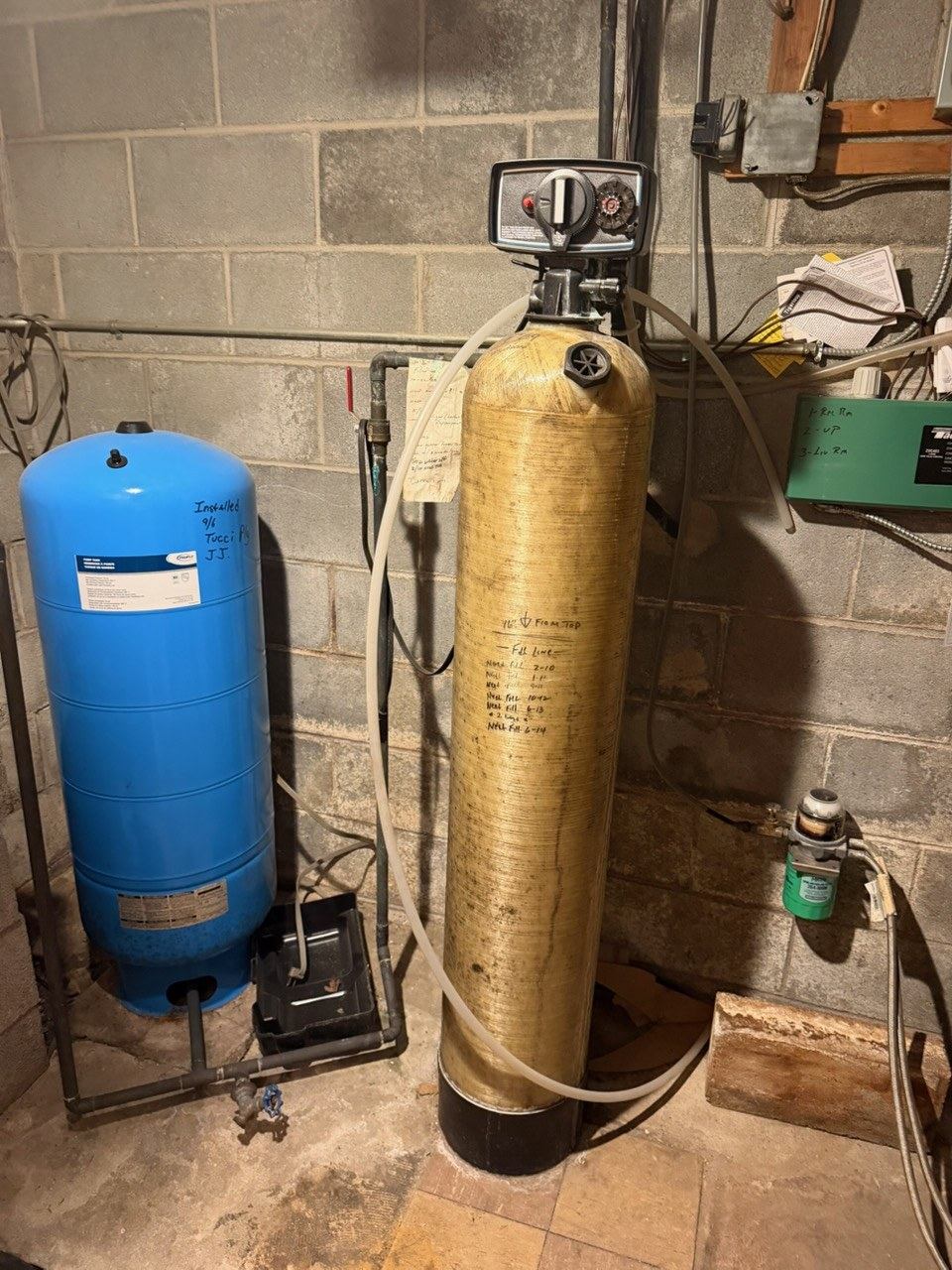
Does Your System Look Like This?
If what's in your basement looks anything like the photo, it's had a long working life and has probably seen better days. Treatment equipment doesn't last forever — media exhausts, valves wear out, and a system sized for a household years ago often isn't sized for the one living there now.
That doesn't automatically mean everything has to go. Sometimes it's a valve or a media change. Either way, give us a call — we'll test the water, take a look at what you've got, and if it needs replacing we'll replace it.
Related Reading
FAQ
Well-Water Questions
In nearly every case, yes. Concentration and interaction drive the design — knowing that iron is present tells us very little. How much, in what form, and at what pH determines whether one approach works and another fails. Pennsylvania doesn't regulate private wells the way public water systems are regulated, so testing is the homeowner's responsibility.
Two wells on the same road can produce meaningfully different water. Depth, the formation the well draws from, construction and age all vary. A system that performs well at one address can underperform at the next — which is why we design from your readings rather than from the street.
Usually it's several components in a deliberate sequence rather than one tank. Sediment filtration first, pH correction where needed, then treatment for iron or sulfur, then softening. The order matters because each stage depends on the one before it.
Periodically, and any time something changes — new odor, new staining, new cloudiness, or after pump work, heavy rain or a dry spell. Wells aren't static. A reading from several years ago may not describe the water coming out of the tap today.
Gridline treats the water. Well and pump work — drilling, pump replacement, casing repair — is a separate trade. If what you're describing points to the well itself rather than the water, we'll tell you and point you toward the right contractor rather than sell you treatment that won't fix it.
Well-water treatment across Greater PhiladelphiaDesigned around your readings, not a default package.
Next Step
Let's Find Out What's Actually in Your Well.
Tell us what you're noticing. We'll evaluate the water, explain what the readings mean, and design around what's actually there.